 Eagerly
Corners, sides and symmetry
How kids learn to tell shapes apart by their sides and corners, and how to find lines of symmetry, with simple activities for home.
What it is
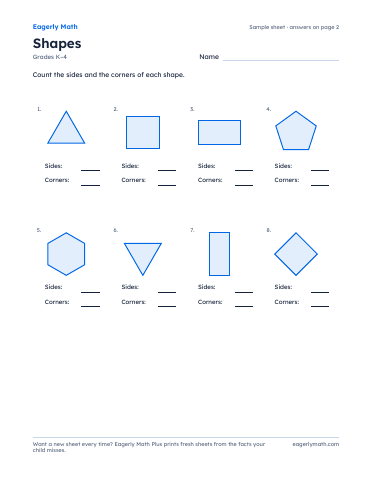
A shape is defined by its sides and corners, not by its color, size or which way it's turned. A triangle has 3 straight sides and 3 corners, always. A line of symmetry splits a shape into two halves that match like a mirror.
Why it's taught this way
Young kids often think a triangle must point up, or that a tilted square is a “diamond”. Counting sides and corners gives them a rule that always works, and it builds the careful looking they'll need for geometry later.
A picture walk-through
- Count the corners on each shape. Then count the sides. They match every time.
- Look at the dashed line on the square. Fold along it and the halves match. That's a line of symmetry.
Things to say at home
- “How do you know it's a triangle?”
- “If I turn it, is it still the same shape?”
- “Can you fold it so the halves match?”
Common mix-ups
- “A diamond isn't a square.” A tilted square is still a square.
- Any line through the middle is a line of symmetry. Only if the halves match when folded. A rectangle has 2, not 4.