Questions grown-ups ask
Short answers to the questions we hear most. Each one links to its topic for more.
My child still counts on fingers. Is that OK?
Yes. Fingers are a ten frame your child always carries, and using them is a normal step in kindergarten and grade 1. Over time, help them move from counting every finger to seeing groups: “a whole hand and 2 more is 7”. Most kids drop fingers on their own once facts become quick.
How do I explain “borrowing” the way school does?
Schools call it regrouping. Instead of “borrow 1 from the 3”, say “trade 1 ten for 10 ones”. 34 becomes 2 tens and 14 ones, which is still 34, and now there are enough ones to take away 8. Dimes and pennies make the trade easy to see.
How much math practice a day is enough?
A few calm minutes most days does more than one long session a week. For young kids, 5 to 10 minutes is plenty. Stop while it's still going well. A short daily habit builds quick facts without making math a fight.
Which times tables come first?
Start with 2, 5 and 10, since they follow skip counting. Then 3 and 4 (4 is double 2). Leave 6 to 9 for last. By then, most of those facts are already known the other way round, like 6 × 3 = 3 × 6. In most US schools, kids are expected to know all facts up to 10 × 10 by the end of grade 3.
Why does school teach math differently from how I learned it?
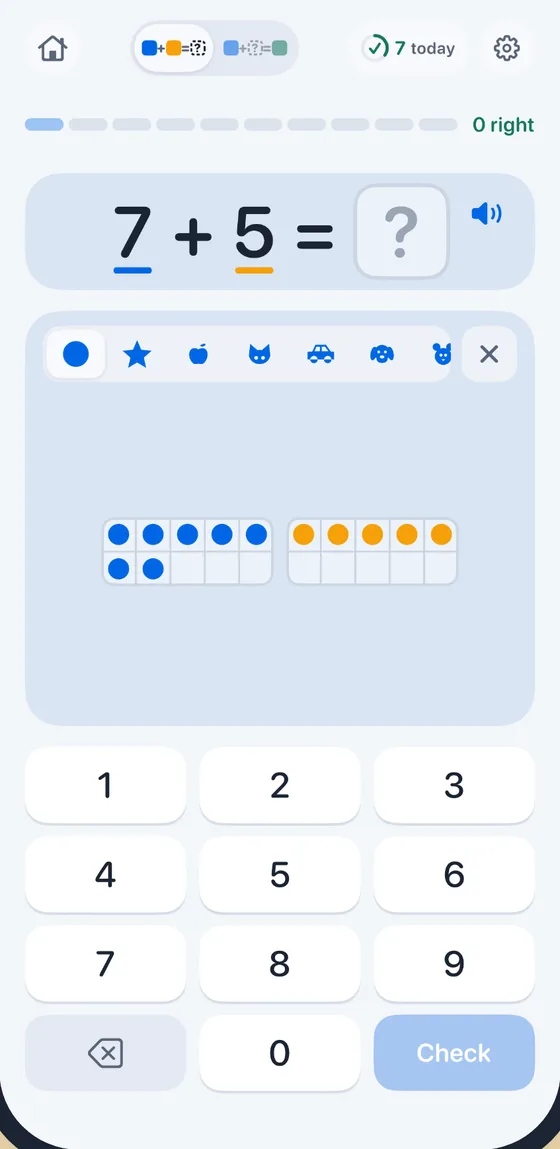
The answers are the same. What's changed is that schools teach why a method works before practicing it, using pictures like ten frames, blocks and arrays. Kids still learn the standard column methods, usually in grades 2 to 4. Asking your child to show you their way is a great way to help.
My child gets upset when an answer is wrong. What helps?
Keep it low-stakes. Say “not quite, try again” without showing the answer, give them time, and praise the thinking rather than speed. Timers and scores add pressure for many kids, so leave them out unless your child asks for a challenge. Eagerly Math works this way: a wrong answer just says “Not quite. Try again.”
My child knows the facts but gets word problems wrong. Why?
Word problems test reading and picturing as much as math. Many kids grab the numbers and guess what to do. Ask them to tell the story back in their own words and draw it before solving. That one habit fixes most mistakes.
Do kids still need to read a clock with hands?
Yes. It's part of grades 1 to 3 in most schools, and it teaches skip counting by 5s and the idea of fractions of an hour. A clock with hands where your child can see it every day helps more than worksheets.
Practice it in Eagerly Math
- The same pictures as these guides
- Show me, when a question is hard
- From counting to fractions, K to 5
- No ads, no tracking, no game rewards