 Eagerly
Fractions start with equal parts, and rounding starts with a number line
How grades 1 to 4 teach fractions as equal parts, why 1/3 is more than 1/4, how fractions sit on a number line, and how rounding to the nearest 10 works.
What a fraction is
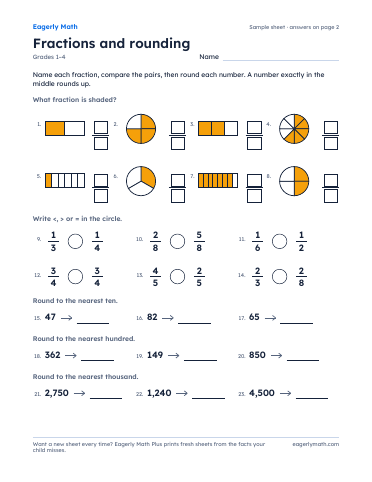
A fraction is a number made by cutting one whole into equal parts. The bottom number says how many equal parts the whole is cut into. The top number says how many of those parts we take.
A picture walk-through
- Halves: 2 equal parts. One part is 1/2. Grade 1 starts here, with the words “half” and “fourth”.
- Thirds: 3 equal parts. Each part is smaller than a half.
- 3 of 8 equal parts is 3/8. In grade 3, kids name fractions up to eighths.
Fractions on a number line
In grade 3, fractions become numbers with their own spot on the number line, just like 1, 2 and 3.
Comparing fractions
With the same bottom number it's easier: 3/8 is more than 2/8, just as 3 slices are more than 2 slices of the same size.
Rounding
Rounding finds the nearest easy number. On a number line from 40 to 50, kids look at which end 47 is closer to.
The same idea works for bigger places: 362 rounds to 400 to the nearest 100, and 2,750 rounds to 3,000 to the nearest 1,000.
Things to say at home
- “Are the pieces fair? Are they all the same size?”
- “Which would you rather have: 1/2 or 1/8 of the pizza?”
- “Is 47 closer to 40 or to 50?”
Common mix-ups
- Parts that aren't equal. A pizza cut into 4 uneven slices isn't cut into fourths.
- A bigger bottom number means a bigger fraction. It's the other way round: 1/8 is less than 1/2.
- Rounding down by habit. 47 rounds to 50, not 40. Look at the digit just right of the place you're rounding to.