 Eagerly
Regrouping, or what we used to call carrying and borrowing
What regrouping means, why schools teach it with tens and ones blocks, and how to explain carrying and borrowing the way your child's class does.
What it is
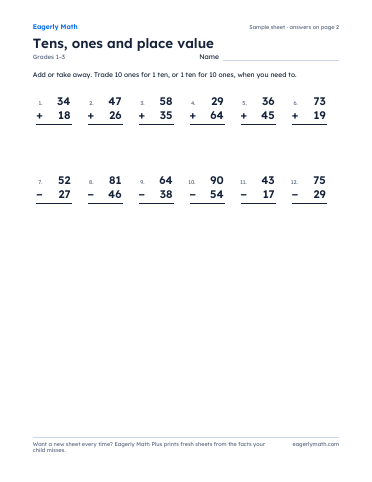
Regrouping is trading between places. When adding gives 10 or more ones, you trade 10 ones for 1 ten. That's carrying. When taking away needs more ones than you have, you trade 1 ten for 10 ones. That's borrowing.
Why schools teach it this way
Many of us learned “carry the 1” as a rule. Schools now show why it works, with blocks first and then in columns. Kids who understand the trade make fewer mistakes, and they can tell when an answer doesn't make sense.
A picture walk-through: 34 − 18
- 34 is 3 tens and 4 ones. You can't take 8 ones from 4.
- Trade 1 ten for 10 ones. Now it's 2 tens and 14 ones, still 34.
- Take away 8 ones and 1 ten. 1 ten and 6 ones are left: 16.
Things to say at home
- “Do we have enough ones to take 8 away?”
- “What can we trade?”
- “Is 34 still 34 after the trade?” (Yes, it just looks different.)
Dimes and pennies work well: trade a dime for 10 pennies.
Common mix-ups
- Taking the smaller digit from the bigger. In 34 − 18, some kids do 8 − 4 = 4 and get 24. Ask “are we taking 8 away, or 4?”
- Forgetting the ten that was traded. Crossing out the 3 and writing 2 above it helps keep track.