 Eagerly
Arrays and fair sharing: what multiplying and dividing mean
How schools teach multiplying with arrays of rows and columns, and dividing as fair sharing, so times tables make sense before they're memorized.
What it is
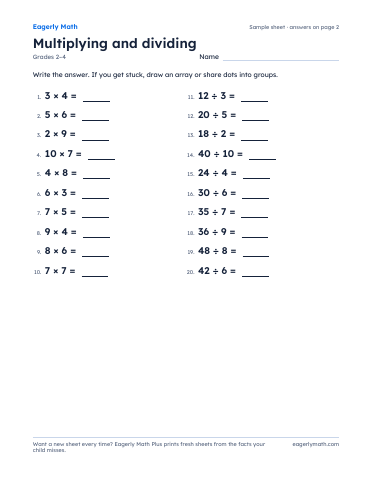
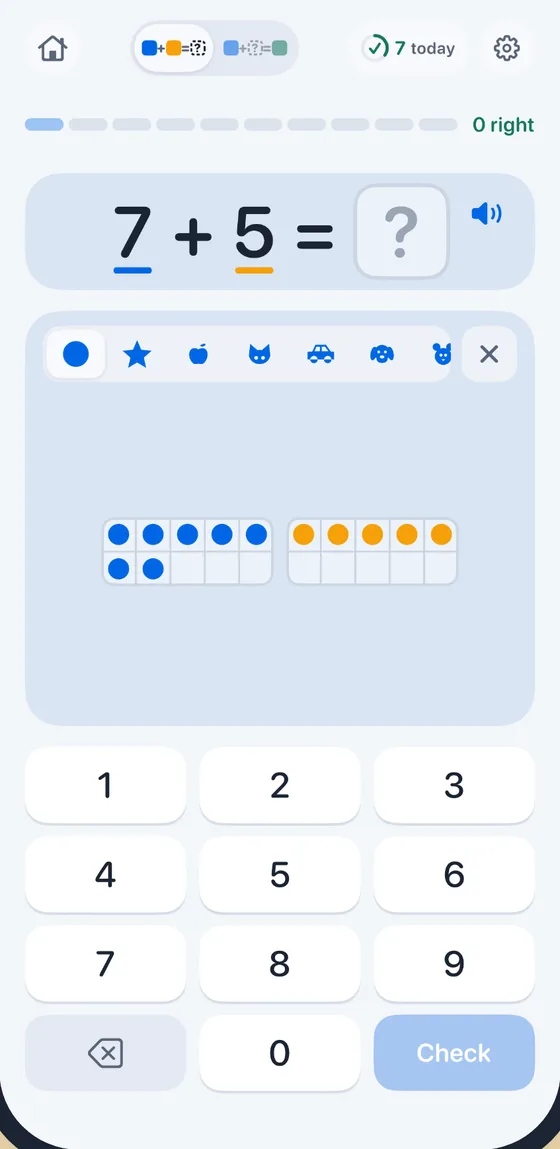
An array is objects in neat rows and columns. 3 rows of 4 shows 3 × 4. Turn it on its side and it's 4 rows of 3, the same 12 dots. Dividing uses the same idea: share 12 into 3 equal groups, and each group gets 4.
Why schools teach it
An array turns a times fact into something kids can count, check and reason about. If they forget 6 × 7, they can work it out from 6 × 5 plus two more rows of 6. Memorizing still matters, and by the end of grade 3 kids are expected to know the tables by heart. The picture makes the memory stick.
A picture walk-through
- 2 rows of 5 is 10. Count by 5s: 5, 10.
- Double the rows: 4 rows of 5 is 20. That's why the 4s table is double the 2s.
- Share 12 fairly into 3 groups: each group gets 4. So 12 ÷ 3 = 4.
Which tables to learn first
- 2, 5 and 10 come first, since they follow skip counting.
- 3 and 4 next. 4 is double 2.
- 6 to 9 last. By then most facts are already known the other way round: 6 × 3 is 3 × 6.
Common mix-ups
- Mixing up × and +. 3 × 4 gives 7 instead of 12. Draw the array and count.
- Thinking dividing always makes things smaller. True for whole numbers for now. Fractions change that later.